'This City is a Battlefield' — Learning History Through Film
Review — Ananda Nilsen
This year’s Film Fra Sør festival has once again delivered many fascinating and touching movies, one in particular came all the way from Indonesia. This City is a Battlefield (Perang Kota) written and directed by Mouly Surya is a historical fiction film based on the novel A Road With No End (1952) by Mochtar Lubis. The film was shown at the festival on the 11th of November 2025 with opening remarks before the movie followed by a Q&A with the director after the screening.

Director Mouly Surya’s 5th feature film, Perang Kota - its title in Indonesian - follows a small family as they fight for their country’s independence. The film brings us through their home city turned battlefield, as well as their marriage as the strains of war begin to crack through. Photo: Ananda Nilsen
A Drama or a War movie?
The film itself is set post-World War Two (1946) and Indonesia is in the midst of their fight for independence as the Dutch grapple for control over their former colony, with the help of British troops—or more accurately using their own colony India for soldiers. To capture this feeling of history, Surya chose a 4:3 aspect ratio to frame the movie, as stated in a panel discussion after the screening, she was inspired by older movies and also felt that this frame captured the characters more intimately. For despite being a war movie, This City is a Battlefield still captures the intimacy and distress of a young couple fighting for the independence of their country.
Synopsis
The movie follows Isa (portrayed by Chicco Jerikho), a war hero turned teacher, who is involved in the organization—a group of freedom fighters operating throughout the city of Jakarta. Isa works with a close friend Hazil (Jerome Kurnia), the son of a man who is involved with high-ranking Dutch officers in spite of the fact that his son works with the resistance. The pair often use Isa’s apartment to plan their missions, where he lives with his wife Fatimah (Ariel Tatum) and son Salim (Ar Barrani Lintang).
The strains of the war begin to affect the couple’s marriage as Isa continuously fails in performing his marital duties. In her frustration, Fatimah turns to Hazil for comfort, adding a layer of drama to an already tense movie. Yet, the movie makes one question if there is anyone to blame in this mess of a situationship? Isa, though loyal to his wife and son, continues to draw back within the relationship for the sake of his country. Fatimah, an intelligent woman who was once a teacher herself, forced into the role of a housewife despite proving her capabilities in conflict earlier in the film. Or Hazil who is spends his life trying to please and impress everyone around him. All of this entangled with the pressure they face fighting for independence, who can question the moral quandary of cheating in a marriage when your city is literally a battlefield?
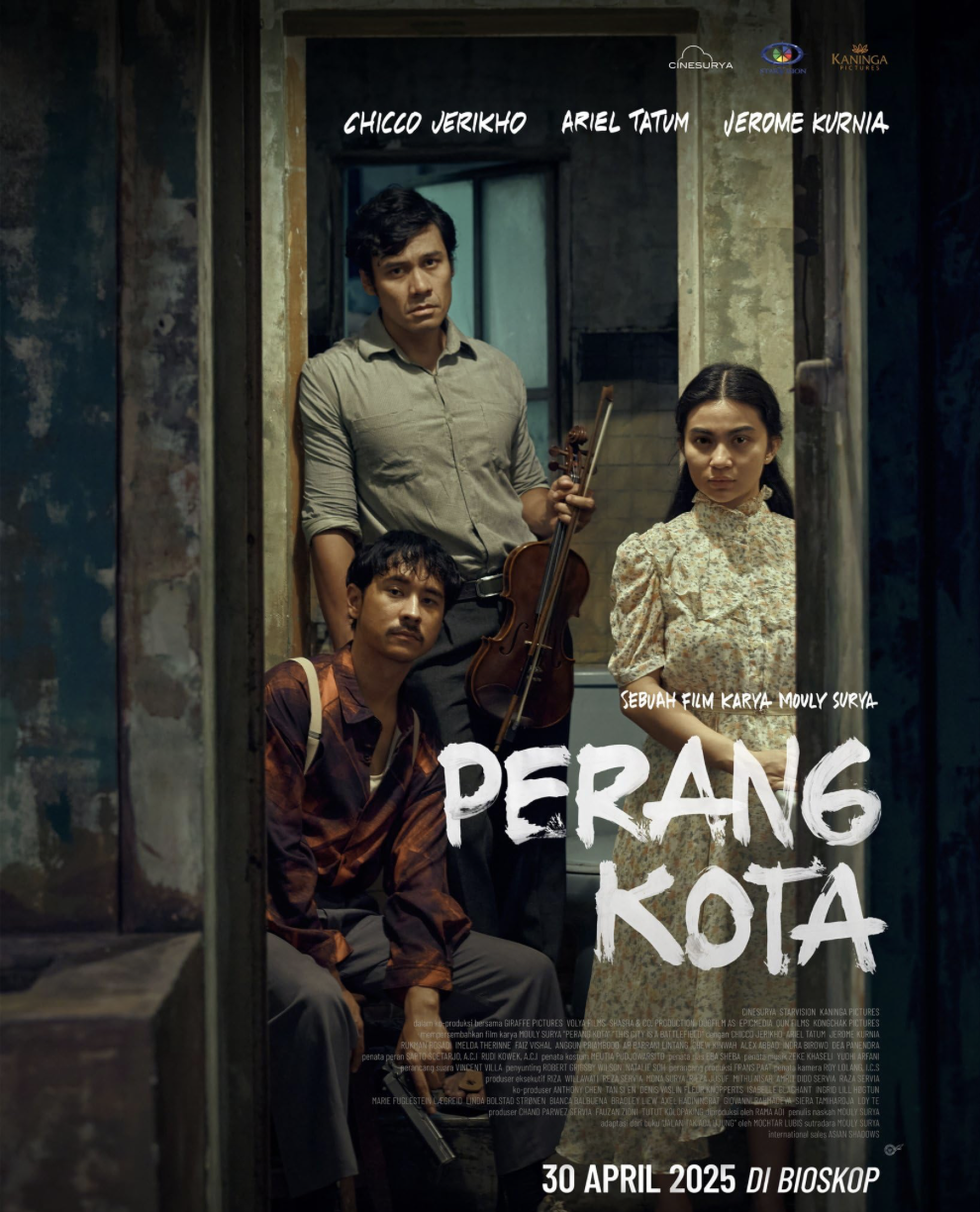
The main trio, the plot revolves around Guru Isa, his wife Fatimah, and close friend Hazil. Photo/Copyright: CineSurya Pictures.
Accuracy in Historical Fiction
During the Q&A held after the screening, director Mouly Surya admitted that she took a few creative liberties when adapting the book into a movie. The book itself is a fiction and published 1952, meanwhile the script was written some 70 years later. Born in 1980, Surya herself did not witness any of this, but recalls learning about it in her early education, and used old pictures of her relatives from this period for inspiration on the costumes.
The movie also shows the characters speaking Indonesian and Dutch, often mixing the two in one sentence. This was mostly reserved for characters of the higher class such as Hazil and his father, and in Isa’s case being a teacher. As well as patrons of the elite café the two later infiltrate. During this time, Dutch was only taught to people of the upper class who stood closer to the Dutch elite, in fact many of the ‘founding fathers’ of Indonesia spoke Dutch as this was the language of education (for those who could get an education). Though it is unclear if they actually mixed it as much as they did in the movie, it is reminiscent of the current youth’s use of English and Indonesian as they consume foreign media whilst learning in the native language.
A Trail of History
One particularly stimulating detail is the crumbs of history told throughout the movie, which opens with an old clip with a British voice-over explaining the conflict as nothing more than trying to bring back peace to the Dutch East Indies. This is not far from the truth as the war for independence was framed as ‘police actions’ instead of an actual war.
The movie continues dropping crumbs of history, which one discovers through dialogue. In one scene we see a group of older men enjoying lunch by a local stall. Here they are discussing the current discrepancies between the independence movement and the foreign troops. One man states that he prefers the Dutch over the Japanese for even though the Japanese were only there 3 years it ‘felt like 30.’
It's during movies like these that one is reminded of Bong Joon Ho’s iconic quote: “Once you overcome the 1-inch tall barrier of subtitles, you will be introduced to so many more amazing films.”
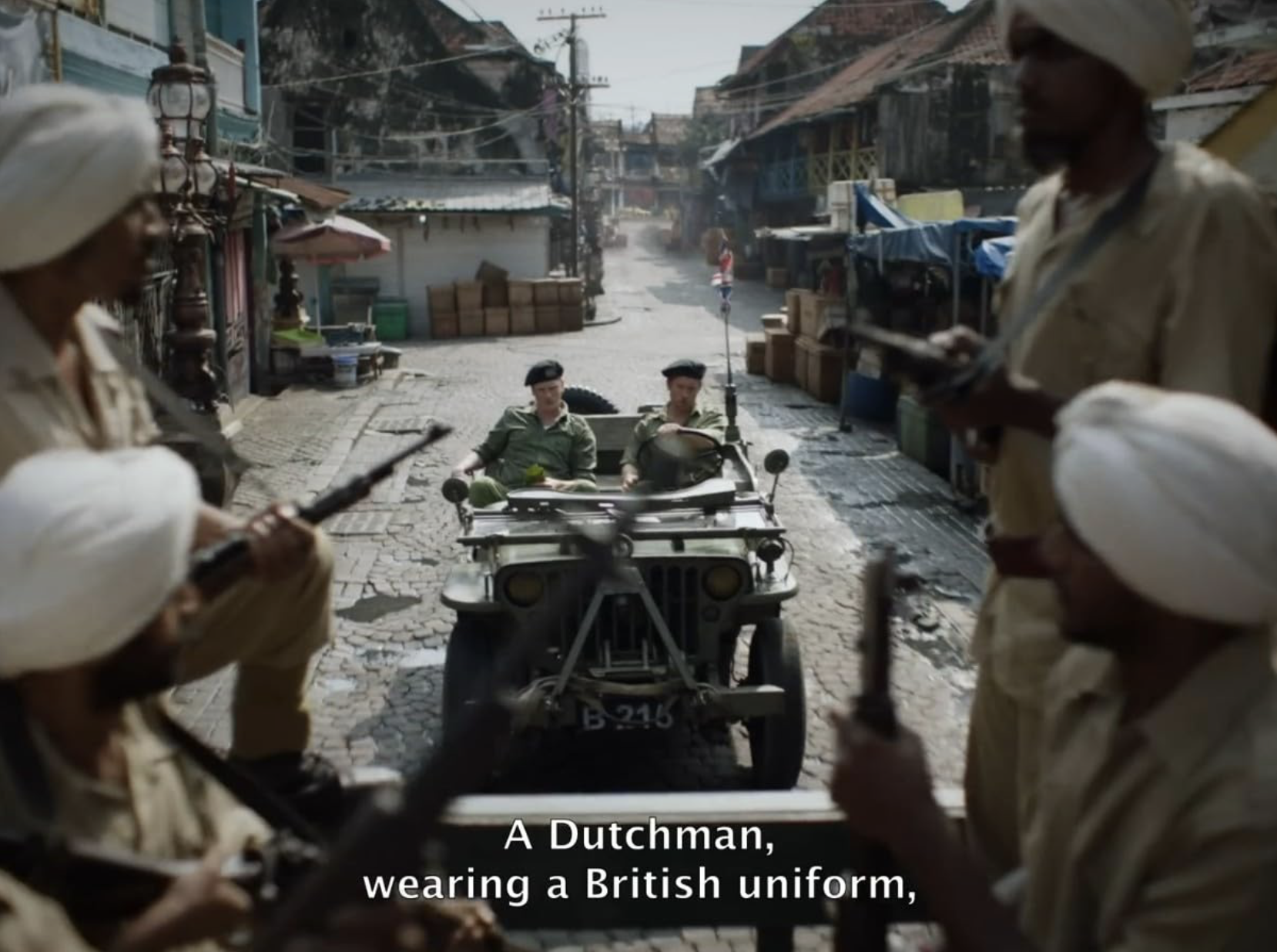
The opening scene of the movie introduces the return of the Dutch with the help of the British. Photo/Copyright: CineSurya Pictures © All Rights Reserved.
Final Thoughts
A cinematic and action-packed experience, This City is a Battlefield manages to combine drama and action making great use of the chosen aspect ratio and soundtrack to suit the mood of the film. Though there were a few moments and themes in the film I would have liked more time on, the plot had an otherwise good flow, one can almost forget that you’re sitting through a 2-hour movie in a completely different language. Who could have thought that a movie could be so educational?