V for Vendetta – a symbol of collectiveness and resistance
Article – Vivien Vetriolo
Graffiti is often dismissed as nothing more than vandalism, another outlet for anarchic youths. However, the artform has historically given a voice to the marginalized and underrepresented, serving as a space for political expression and underground communication. It is this function that is explored in the movieV for Vendetta.

Image: Hin Bong Yeung / Unsplash
Graffiti - a tool of expression
Graffiti has long been an expression for art, crime and political views. It is usually found on walls, trains and on public buildings created by an anonymous group of marginalized voices, giving them a right to speak. Graffiti serves as a form of expression for individuals and communities, and communication between them.
In visual culture graffiti turns into a device that transmits narratives. Urban environments are being turned into political ones, expressing social tensions and ideological conflicts among a community. The communication works without any verbal dialogue, the presence of the graffiti is expressive enough and conveys meaning. Often seen in dystopian movies is graffiti’s function as a political and symbolic language. In V for Vendetta, the graffiti of one person mobilizes a resistance.
V for Vendetta

Image: Mateusz Sobocinski / Unsplash
V for Vendetta, a movie directed by James McTeigue and released in 2005, is about a dystopian future Britain, which is ruled by a regime known as Norsefire. The government controls its citizens through strict surveillance, manipulates them with propaganda and fear, resulting in a general oppression of freedom and political opposition.
The movie portrays the story of a masked revolutionary wearing a mask and known as V. The unknown individual uses acts of sabotage and symbolic violence against the regime. When V rescues Eve Hammond (Natalie Portman), a young woman in danger, she becomes involved in his campaign against the regime. Throughout the movie V exposes the government’s past crimes, such as experiments that were used on civilians. Said experiments led to V’s own disfigurement.
The political movement of the anonymous revolutionary continues to grow, with his symbol - the graffiti V and his mask - spreading among the country. This leads to the population uniting against the government, destroying their attempts to surpass the movement. The movie finishes with the blow-up of the parliament, resulting in the collapse of the regime.
Political resistance through graffiti
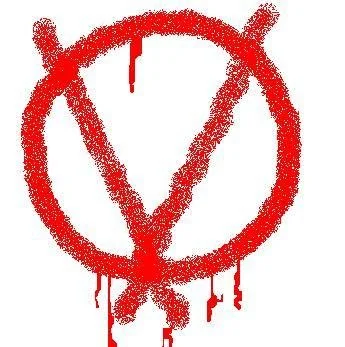
Image: Commons Wiki
Graffiti has always been used to express a political statement from marginalized groups. Its publicity and anonymity make it difficult for the government to track and regulate. In V for Vendetta the graffiti ‘‘V’’ functions as a political statement, being used as a strong political mechanism. It functions as a form of virtual resistance throughout its anonymity and repetition. Being seen as a criminal signature at the beginning, the meaning of the single letter shifts throughout the movie. The more people join, the more it turns from an individual vendetta to a collective resistance against the state. The graffiti V challenges directly the government and its authority, reason for that being the occupation of public spaces that would otherwise be dominated by propaganda.
In the final scene of the film, where the symbol is being used by the larger part of the society, the V represents a revolutionary idea, which spread as a political transformation. The film adopts the idea that political change comes with shared ideas that people choose to adopt.
The movie demonstrates that graffitis can be used as more than just visual motifs. It becomes a political language and a symbol for resistance.